Choosing the crosshair in Counter-Strike 2 starts with understanding what actually helps your aim and what quietly works against it. When you’re using genuinely good CS2 crosshairs — you barely notice them — and that’s the whole point. It is a reference point that helps your eyes and muscle memory align shots without even thinking.
- He plays the AWPer and IGL role in his teams, cooking up strategies and tactics to win matches.
- Doing so will help you revert to the previous one if you don’t find the new ones useful.
- You can choose the method you want and create your personal CS2 crosshair settings.
- Professional players fine-tune their crosshairs for maximum precision and to suit their playstyle, which means they can vary in color, size, and style.
- NiKo’s crosshair has thicker outlines and a tighter inner gap, which makes it easier to aim precisely.
Sets of CS2 crosshair console commands look massive, but adding them to the game is a pretty straightforward process. These players obviously know the type of crosshair that helps them win Counter-Strike 2 matches and tournaments. Adjusting CS2 crosshair settings for this purpose may take time and effort, as you need to check out how your ideas work directly in the game. Your accuracy strongly depends on how comfortable the crosshair is specifically for your personal style and preferences. This process sure includes the CS2 crosshair, which is visible on screen throughout your matches.
I find that this makes it much easier to line up headshots from afar, but your mileage may vary. If you make a change that you’re not happy with, you can simply follow the above method once again to revert to the default settings for it. If those in the list above weren’t to your liking, there are plenty of additional crosshair codes from players or streamers that can also be used. The medium thickness of the lines make it stand out in all environments, which creates a strong contrast that helps you to spy enemies better. Speaking from experience, having a clean and simple crosshair can make or break your aiming ability. Customising your crosshair in Counter-Strike 2 can make a huge difference to your performance, so here’s a list of the best pro-player crosshairs in CS2.
Browse Pro Player Crosshairs
This shows that role matters, but it doesn’t decide the whole crosshair. Kyousuke’s crosshair is similar to m0NESY’s, but it’s a little thicker. Green helps keep the crosshair readable on many CS2 maps. His https://adept-games.com/device-on-astralis-rebound-it-was-good-for-me-to-have-a-reset-2/ settings leave more space in the center, which helps during spray control because the target stays visible between the lines. ScreaM’s settings are another example of a larger crosshair — taking up more screen space than most pro setups. A brighter look is often easier to track during fast fights, especially in darker map areas.
We recommend this «average pro» crosshair to players who need a starting point. We looked into creating a crosshair using the average settings of all the CS2 pros. Using a crosshair preference of your favorite pro can boost your confidence and comfort during gameplay.
- Rounding at the sub-pixel level and scaling in screen-space vary between Source 2 and a browser — so don’t anticipate pixel-perfect results; however, the shape, size, gap, and color align with the shared code.
- Start with a proven pro setup (then adjust it for your resolution), role, and visibility preferences.
- The best way to do this is to practice in a controlled way and then carefully look over your own gameplay.
- “Your crosshair should match your comfort and playstyle, not just what pros use.
Simply click on the code from the aforementioned list to copy it to your clipboard.
If you aim to replicate the success of Counter-Strike 2 professionals like Donk — S1mple, or ZywOo, take a look at this list and select your preferred crosshair. The profiles also showcase the skins used by CS2 players, making them the most comprehensive resource for those interested in how professionals configure their games. Additionally (you can assess whether it improves your visibility), precision, comfort, and other critical aspects based on your playstyle across various maps in the competitive pool. Several other professionals listed here have similar preferences to Frozen, opting for a green crosshair. The Latvian professional prefers a slightly larger crosshair compared to some of the dot-style options on this list, making it ideal for those who support native resolution and need a bigger aiming reticle. This discussion will equip players with the finest crosshair codes from top Counter-Strike 2 professionals like S1mple, ZywOo, and NiKo, allowing for easy imports to enhance gameplay.
A gap of -3 is most used in the pro scene , with 45% of pros using that value,, with -2 (28%) and -1 (15%) being the second most used gap values. A large gap can be beneficial for target acquisition because there’s a lot of visual reference for where your crosshair should go, but it can give you problems when you need to aim precisely given the fact that there’s no aiming reference in the middle. Pros who only use a dot are in the minority (22% are using a dot — either as part of their crosshair or as the sole crosshair element) but it’s obviously encouraged to experiment with this and find something that works for you. Adding a dot to the center of your existing crosshair can be the best of both worlds in a way — but it does make for a crosshair that covers an awful lot of the screen. You can (for example), have a dot in the center of your otherwise dynamic crosshair so that you always know where the center of your screen is. For spraying it can be detrimental to have a dynamic crosshair though, as its expanding nature might mean that you lose track of where the center of the screen is.
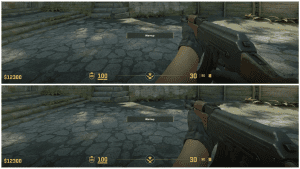
S1mple employs a clean dot crosshair in the Classic Static style, which is well-suited for accurate aiming. Our research into the preferences of professionals such as s1mple, jL, donk, and others serves as a foundation for discovering the optimal crosshair settings for your setup. It is infrequently utilized — and we recommend disabling it for a more reliable aiming experience.